
Return Voyage: Post Captain
Patrick O'Brian's high comedy, or: The Bear and the Bees

[A second look at the second novel in the Aubrey-Maturin saga. But before we get to it, let me remind you that Pulitzer-prize winning novelist Adam Johnson calls my new novel, The Last Words of Jack Ruby, “taut, lyrical, and deeply unsettling,” while Avner Landes describes it as “a great American novel, a great Jewish American novel, and a great novel about the lifelong friendship between a success and the shlub who never quite catches up.” Pre-order your copy today!]
In my original essay on the second novel in the Aubrey-Maturin canon, I noted its polarizing effect on fans of the series. For every reader who treasures, as I do, its homage to Jane Austen and the marriage plot there’s a reader who finds Post Captain too much of a loose, baggy monster: overlong, riven with implausibilities, and with most of the exciting sea action deferred to its last third. The sentiments of this Reddit poster seem pretty typical:
I’d tried reading “Post Captain” over a decade ago and found it a chore. The prose was impenetrable, I thought, and the drama dull.
But re-reading the novel recently has been a whole new experience. This is IMO one of his finest written novels, one which expands the limits of its genre, and it’s all told with such bravura and confidence.
The novel, of course, didn’t change over the course of that decade; the reader did. And I am reminded of how O’Brian himself, though he chose to write in a mode associated with the boy’s adventure story, was already in his mid-fifties (exactly my present age, in fact) when Master and Commander was published. There’s a kind of feint, then, built into the circumstance if not the structure of the canon: what might present itself initially as a swashbuckling story for younger readers is in fact the product of a great deal of age, experience, and disappointment. The gap between the youthful high spirits the novels are so good at channeling, principally through the character of Jack, and the deep melancholy of the middle-aged author, gives O’Brian’s writing much of its flavor.
That mixed flavor—of high spirits and melancholy—is essentially comic, and page for page, book by book, Patrick O’Brian is one of the funniest writers I’ve ever read. But would you believe that were true after reading this diary entry written by Stephen Maturin from the last chapter of Post Captain?
So much wretchedness, misery and squalor I do not believe I have ever seen collected together in one place, as in this town of Plymouth…. When I let my mind dwell on the vast potentiality for happiness, and our present state? Such potentiality, and so much misery? Hatred the only moving force, a petulant unhappy striving – childhood the only happiness, and that unknowing; then the continual battle that cannot ever possibly be won; a losing fight against ill-health – poverty for nearly all. Life is a long disease with only one termination and its last years are appalling: weak, racked by the stone, rheumatismal pains, senses going, friends, family, occupation gone, a man must pray for imbecility or a heart of stone. All under sentence of death, often ignominious, frequently agonizing: and then the unspeakable levity with which the faint chance of happiness is thrown away for some jealousy, tiff, sullenness, private vanity, mistaken sense of honour, that deadly, weak and silly notion.
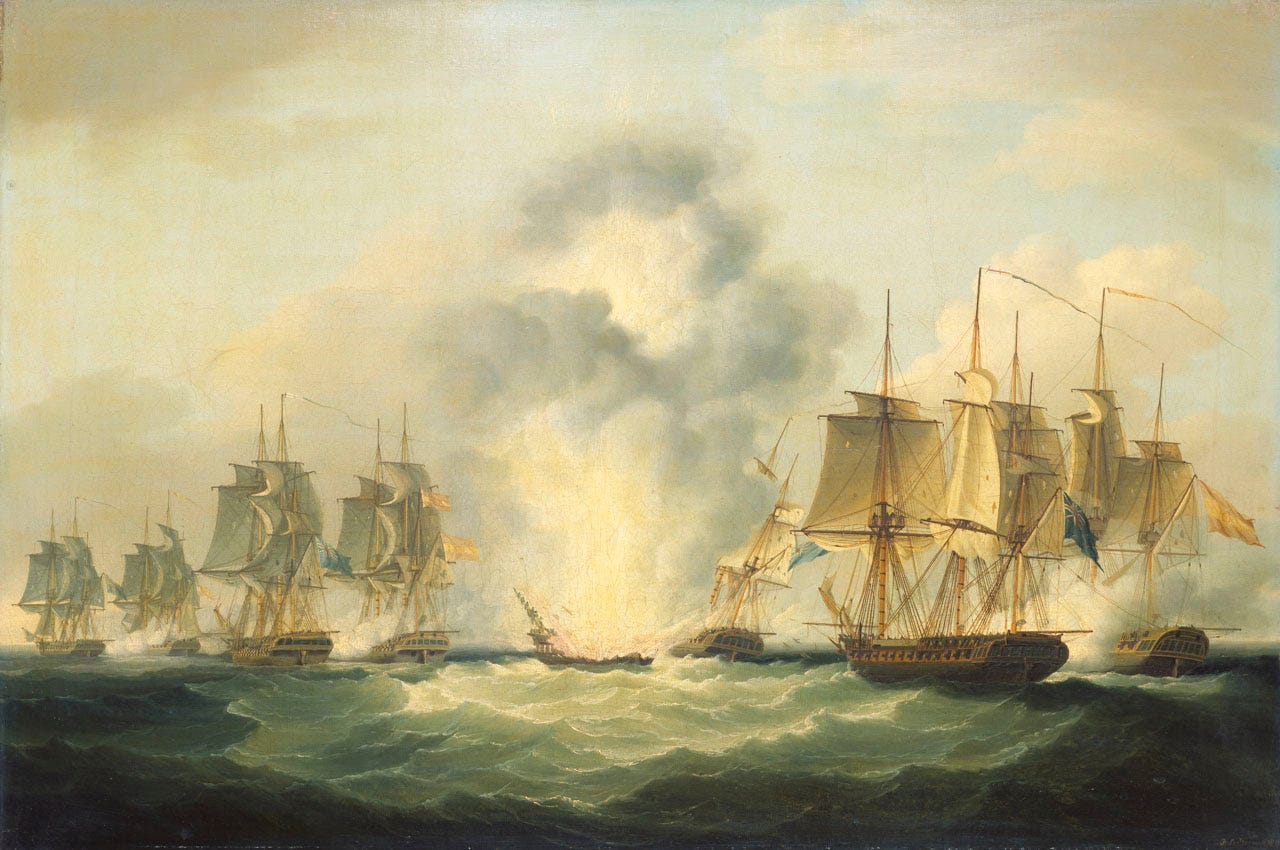
This is Stephen at his lowest, in the grip of the black dog of depression. Diana, the woman he loves, has abandoned her affair with his best friend and gone into keeping with Canning. In this desolation he has been denied the compensation of seeing at least Jack and Sophia happy; Sophia, at her last interview with Stephen, quailed at the prospect of defying her mother and hitching a ride on Jack’s ship, the Lively, so that they might at least achieve an understanding. The veil of joy is torn, and the bleak reality of aging, loneliness, and death leers at us through the holes. Yet it is just these glimpses of darkness that give the comedy of the books its savor—comedy in the sense of humor, comedy in the sense of happy ending and success. A few sentences later, just as Stephen is lamenting Sophia’s lack of courage, he looks up through his cabin window and sees her face. Love has triumphed after all; Sophia has taken his advice and come with her sister Cecilia to join the Lively, and before long she and Jack have pledged never to marry anyone else. Not long after that, the Lively will take part in the attack on the Spanish treasure ships that will result—at least as far as he and the reader knows in Post Captain’s last pages—in the fortune that will clear Jack’s path to marrying Sophia at last.
Comedy, we are told, derives from the Greek κωμῳδία, a compound of κῶμος kômos "revel" and ᾠδή ōidḗ "singing, ode." There is plenty of singing in these novels, and plenty of revelry. Perhaps the most memorable such scene in Post Captain comes just past the novel’s midpoint, when Jack hosts Canning for dinner aboard the Polychrest. Jack, anxious and impoverished, and sensitive about commanding an awkward, unlovely vessel known throughout the fleet as “the Carpenter’s Mistake,” is rescued by the generosity of Sophia, who sends him hampers full of enough food to serve the wealthy merchant in style. When he comes aboard the likable Canning immediately sets Jack and his officers at ease, and even does something of a pratfall when he leaps to his feet to make the loyal toast and strikes his head against the ceiling. By the end of the feast, more than a few sheets to the wind, Jack and Canning and the others are singing “Green Grow the Rushes, O” at the tops of their lungs (it’s a pleasure to hear Patrick Tull, in the audiobook version, sing this):
Three, three the rivals
Two, two the lily-white boys, clothed all in green-o,
But one is one and all alone
And evermore shall be so
It’s a rather mysterious song; my daughter used to sing it in preschool; Wikipedia describes it as “an unusual mixture of Christian catechesis, astronomical mnemonics, and what may be pagan cosmology.” But really the song is a comment on the action: Jack, Stephen, and Canning are the three rivals for the affections of Diana Villiers; when Diana goes to India with Canning she leaves Jack and Stephen “the lily-white boys, clothed all in green-o”—that is, green with jealousy. And at the novel’s end, Jack and Sophia’s happiness seems all but assured but Stephen is more than half-convinced that he is “one and all alone / And evermore shall be so.” The reveling song of comedy has the seeds of tragedy in its throat.
But sometimes Post Captain, like the other novels in the series, is gut-bustingly funny, never more so than when animals are involved. This is why comparing O’Brian to Jane Austen doesn’t quite do him justice. Yes, he is capable of social comedy—the comedy of manners—at a very high level; go back to my original post to read about his incisive depiction of Sophia’s mother Mrs. Williams, one of the great comic monsters in all literature, like Mrs. Bennet from Pride and Prejudice on steroids. But O’Brian is also capable of a Rabelaisian slapstick that Austen never attempted, just as she does not attempt to give characters to any of the many servants attending the likes of Fitzwilliam Darcy or Emma Woodhouse, let alone their horses. O’Brian’s earthier flights come in the form of frequent double entendres, as when Mrs. Miller (shades of Chaucer’s Miller), the young wife of a naval officer, is put out of the way so that the Lively might exercise of the great guns: “Mrs Miller had been desired to step down into the hold, with a midshipman bearing an armful of cushions to show her the way: asked if she minded a bang, had replied, ‘Oh no, I love it.’” Snigger! And there’s plenty of scatological humor in the books, as when Stephen, in H.M.S. Surprise, gives a laxative to the midshipmen who’ve eaten the rats upon which he was experimenting with madder, so he can see if the rats’ bones have turned red. But the most memorable, laugh-out-loud moments of comedy always seem to involve animals. And here again, the key to the richness of O’Brian’s comedy has to do with the role of Stephen Maturin.
Stephen’s melancholy, his loneliness, and his tragic sense of life make him not just the yin to Jack’s yang but the ballast, as it were, for the novel’s comedy in the macro sense: the comedy of success and reconciliation, reflected in the novels by three mechanisms: marriage, promotion, and the accumulation of wealth. Both heroes eventually marry, and while neither man’s marriage can be called straightforwardly happy, each is immeasurably enriched by his marriage, most tangibly in the production of children: Jack’s lower-deck-literate twins Charlotte and Fanny and his son and heir George; Stephen’s beloved Brigid, who is miraculously ushered out of autistic darkness by Padeen, a Magical Irishman if there ever was one. Jack, of course, climbs the ladder of promotion steadily, save for the hiccup that gets him temporarily booted out of the Royal Navy in The Reverse of the Medal, and by series’ end he is an admiral at last. Promotion is not so straightforward for Stephen—he starts as a surgeon and ends as a surgeon—but his successes in intelligence and as a naturalist build him up steadily in stature and reputation. Money, meanwhile, comes and goes for both men, and both are financially reckless—Jack because he can’t resist a get-rich-scheme, Stephen because he’s absent minded—but they end the series as men of considerable means.
But Stephen isn’t merely a counterweight to Jack because of his inclination toward pessimistic gloom; he is also a scientist. And there’s nothing funnier or more touching in these books than when Stephen, in his capacity as natural philosopher, relaxes his cunning and puts aside his melancholy and becomes completely, undefendedly innocent. Here again he shows himself to be Jack’s counterpart, for Jack, though as wily a sea commander as can be imagined, displays an open-hearted innocence in most of his relationships and his capacity for joy. Even Diana, having once complained to Stephen about Jack’s immaturity (with clear implications for his deficiencies as a lover), later tells him, "Do you remember – oh how long ago it seems – I told you he was little more than a huge boy? I was pretty severe about it: I preferred something more mature, a fully-grown man. But how I miss all that fun and laughter! What has happened to his gaiety? He is growing quite a bore. Preaching and moralizing.” Jack likes most people, and expects other people to like him; his delight in low puns and the daddest of dad jokes is part of his considerable charm. Preaching and moralizing—the heaviness brought upon him by his guilty conscience—don’t suit him at all.
Stephen, meanwhile, is suspicious and unforthcoming with others, especially if they ask him questions. But put a sloth in Stephen’s arms, or an aardvark before his magnifying glass, or fill a glass hive with bees, and he is utterly transformed into a childlike being. When Stephen brings that glass hive aboard the Lively it is the occasion for high comedy, as in this passage when Jack enters his darkened cabin to find Stephen and his apian friends within:
‘They are remarkably adaptable – perhaps the most adaptable of all social insects,’ said Stephen, from another part of the cabin. ‘We find them from Norway to the burning wastes of the Sahara; but they have not grown quite used to their surroundings yet.’
‘Oh God,’ said Jack, scrabbling for the handle. ‘Are they all out?’
‘Not all,’ said Stephen. ‘And learning from Killick that you expected guests, I conceived you might prefer them away. There is so much ignorant prejudice against bees in a dining-room.’ Something was crawling on Jack’s neck; the door had completely vanished; he began to sweat heavily. ‘So I thought to create an artificial night, when, in the course of nature, they return to their hive. I also made three fires for the sake of the smoke: these did not have the desired effect, however. It may be that the darkness is too complete. Let us compromise with a twilight – dark, but not too dark.’ He raised a corner of sailcloth, and a beam of sun showed an incalculable number of bees on every vertical surface and on most of those that were flat; bees flying in a jerky, meaningless fashion from point to point; fifty or so sitting on his coat and breeches. ‘There,’ said Stephen, ‘that is far, far better is it not? Urge them to mount on your finger, Jack, and carry them back to their hive. Gently, gently, and on no account exhibit, or even feel, the least uneasiness: fear is wholly fatal, as I dare say you know.’
Jack had the door-handle; he opened it a crack and glided swiftly through. ‘Killick!’ he shouted, beating at his clothes.
‘Sir?’
‘Go and help the Doctor. Bear a hand, now.’
‘I dursn’t,’ said Killick.
‘You don’t mean to tell me you are afraid, a man-of-war’s man?’
‘Yes I am, sir,’ said Killick.
I can’t read this, or hear Patrick Tull narrate it, without laughing out loud. The juxtaposition of Stephen’s rationality—shot through with the innocence of his pure love for the animal world—with Jack and Killick’s panic is irresistibly comic. Jack would love to evict Stephen’s bees from his ship, but one glance at his friend’s suffering face is enough to persuade him to leave them bee. The bees help Stephen to escape from his despair over Diana, just as the bear-suit helped Jack escape from France. Both incidents are funny, as are many other of the incidents in this novel involving animals—think of the discontented gelding Jack rides in Sussex:
If the moods that succeeded one another in its head had taken the form of words they would have run, ‘Too heavy – sits too far forward when we go over a fence – have carried him far enough for one day – shall have him off presently, see if I don’t. I smell a mare! A mare! Oh!’ Its flaring nostrils quivered, and it stamped.
Or when Mr. Midshipman Babbington, who has gotten a little too familiar with Mrs. Villiers while driving her to Jack’s ball, is quashed by the following:
The horse slowed to a walk – the bean-fed horse, as it proved by a thunderous, long, long fart.
‘I beg your pardon,’ said the midshipman in the silence.
‘Oh, that’s all right,’ said Diana coldly. ‘I thought it was the horse.’
Later in the series O’Brian will create the character of Parson Martin, whose innocent love of the animal kingdom is combined with an accident-prone tendency to get himself bitten, clawed, and otherwise mauled by the objects of his affection—much as Stephen, in a crueler key, finds himself clawed and mauled by Diana.
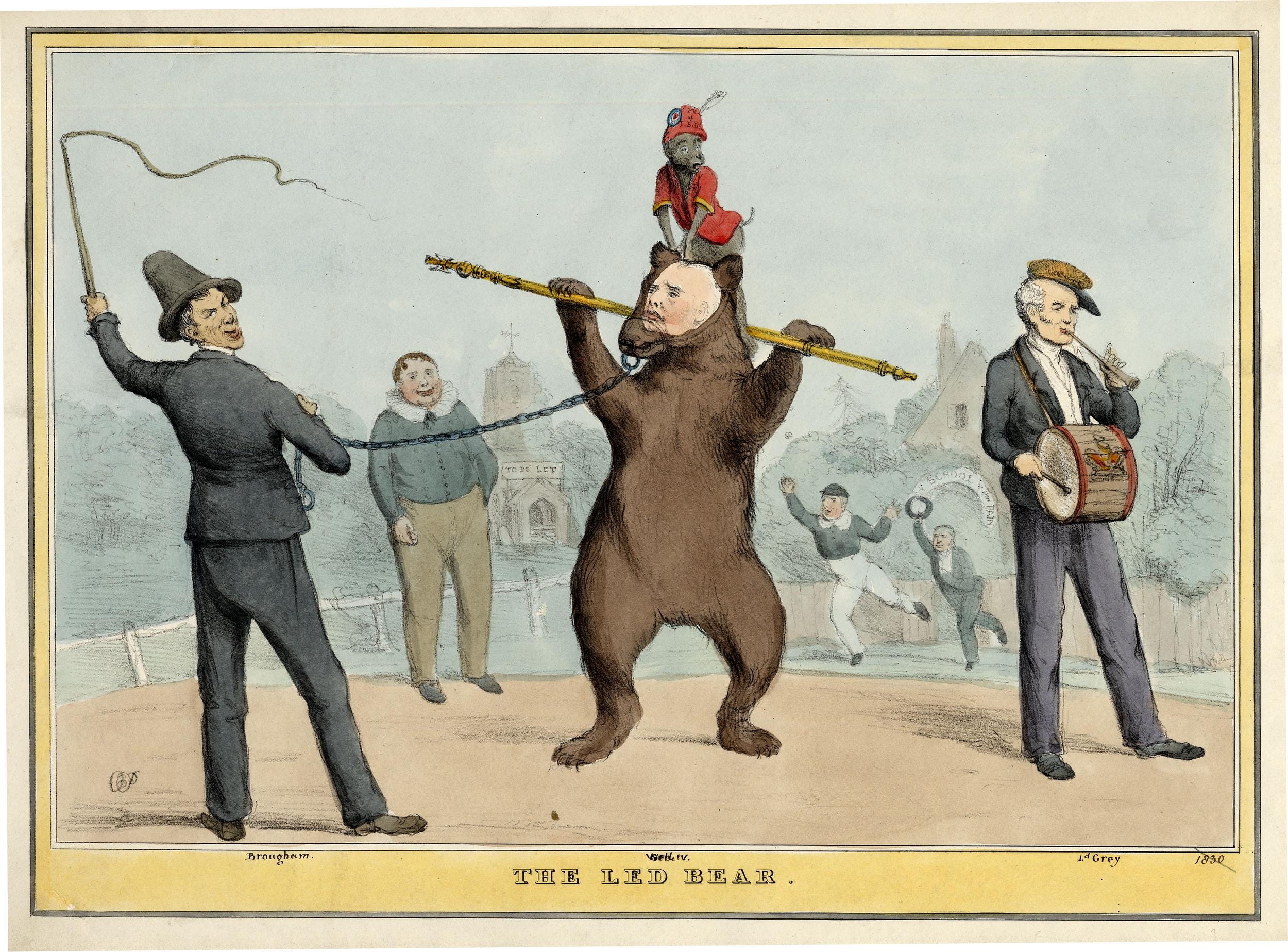
Cruelty is one of comedy’s more disquieting notes, which brings us to the notorious incident of the bear. Many readers have trouble suspending disbelief enough to enjoy this superlatively comic episode, in which Jack is disguised as a bear (a sow called Flora) and Stephen as the bear’s handler so that the two of them might evade French patrols and escape over the border into Spain. It does strain credulity that a man in a bearskin could be taken for a genuine bear; given the meticulous illusion of historical reality for which O’Brian is famous. (Though to be fair, O’Brian apparently based this on an actual incident: in the mid-18th century, an Irish priest living in France came across a remarkably well-trained performing bear who turned out to be one of his countrymen, a monoglot man from Waterford.) But what we are given in this gloriously funny section is more like a pantomime, a game in which all the players are complicit, than a strict bit of realism. It smacks of the fairy tale. Stephen’s love for animals is more pure than his love for any human being, so is it not fitting that he should transform his particular friend, the bearlike Aubrey, into the most lovable possible form of an actual bear? A bear who can dance a hornpipe, forsooth.
Yet there is something of a cruel note to how Stephen handles Jack-the-bear, in his steadfast insistence on Jack’s keeping the skin on, in spite of the incredible discomfort, and even refusing to discard it once they’ve reached the safety of Stephen’s castle in Spain: “The bear may serve again.” One might chalk this up to rigor, and Stephen’s desire to preserve his friend’s life taking precedence over Jack’s comfort. But there is a disquieting relish to Stephen’s role as the bear-keeper that echoes the flip side of his innocence—the notorious “reptilian” quality that makes him as efficient a killer as he is a healer. He has, under the cover of saving Jack’s life, the opportunity to punish him for his romantic success with Sophia and Diana, to try to sear a bit of the boyishness out of him. In that he resembles his author. A storyteller who is unwilling to be cruel to his characters will not, in the end, bring much vitality to his storytelling. The imperatives of comedy, which grow as the series goes on, make O’Brian’s creatures harder to punish, which may be why he kills off major characters with shocking abruptness in the later novels. The black mood that falls upon Stephen at Plymouth is probably closer to the aged O’Brian—especially after the death of his wife, Mary—than Jack at his lowest could ever be.
Still and all, Jack is rescued—and later, in H.M.S. Surprise he will rescue Stephen from the hands of the French in far more dashing and tender style. Near the novel’s opening, Jack is the heroic horseman, while Stephen rides a mule, “swarming along in its inhuman way.” When the inhuman rears up in the human animal we must laugh or else shrink with dread. But indifference to O’Brian’s creatures is impossible to imagine.
Thank you for this article. It's good to be reminded how enjoyable the Aubrey-Maturin series is. You've done a good job unpacking why the humour works so well, and, more impressively, doesn't feel particularly dated so long after it was written.
"one of the funniest writers I’ve ever read" - yes - where else do I laugh aloud - not at the bear and bees though