
Minor Characters: Killick! Killick, there!
Which it's everybody's favorite "cross-grained bastard" of a steward

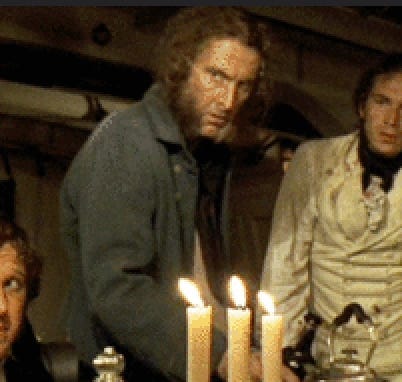
I am already in trouble with my title: how dare I call Preserved Killick, Jack Aubrey’s faithful if cantankerous steward (not to mention Stephen Maturin’s self-appointed keeper), present from the very first novel to the very last, “minor”? Partly this is just for consistency’s sake, to fit this post with my series on the canon’s minor characters (including Richard Canning, Louisa Wogan, Jagiello, and Napoleon Bonaparte). And if I can term Mr. History-on-Horseback himself, without whom the titular Napoleonic Wars wouldn’t have occurred, a minor character, why not Killick? Nonetheless I find myself in treacherous waters, because there is probably no secondary character in the canon, other than Barrett Bonden, as beloved as that “mumping villain,” a servant with a million vices and only two virtues: polishing silver and making coffee (“but these,” writes O’Brian in The Commodore, “he possessed to such a high degree that for those who liked their plate brilliant and their coffee prompt, freely roasted, freshly ground and piping hot it was worth putting up with his countless vices.”)
Neither recurring character nor secondary character roll off the tongue as well as minor character, so my heading will stand. Killick is minor in the sense that his actions rarely, if ever, have much bearing on the plot of this or that novel; but as a flavoring agent he is rich, as comic relief he is peerless. As the secret sharer of what I believe to be the novels’ essence—the homosocial utopia of Jack and Stephen’s wooden world—he is downright essential, “the secret man of the world,” to borrow a phrase Stephen uses to describe Jack.
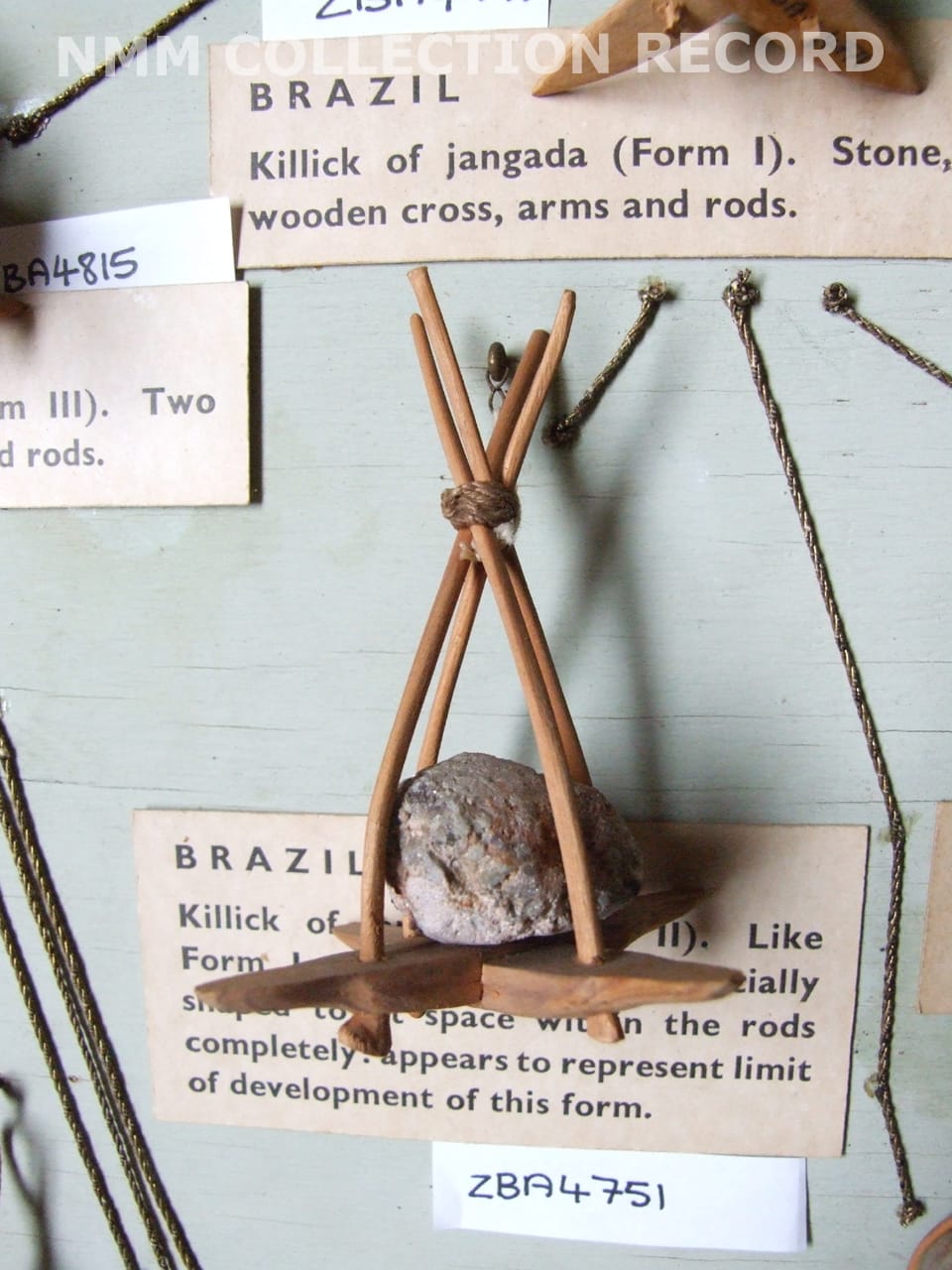
A killick is a small, improvised anchor; it’s a word of uncertain origin, possibly Gaelic. It’s an entirely fitting name for Jack’s steward, “an ill-faced, ill-tempered, meagre, atrabilious, shrewish man who kept his officer’s uniform, equipment and silver in a state of exact, old-maidish order come wind or high water” (The Hundred Days). Words like shrewish and old-maidish hint at a certain feminizing or maternal quality, as perhaps does his unusual first name, Preserved (which not only reminds of the name of the American jurist Learned Hand but subtly echoes the virtue-centric names of the Quakers and Puritans: Praise-God Barebone, Humility Cooper, Remember Allerton, etc.). Killick’s abrasive, “atrabilious” personality suggests the sort of preservation I associate with being immersed in brine or vinegar. But Killick is not merely preserved in a state of permanent sourness, like a dill pickle; he is a preserver of Jack and Stephen’s comforts, and, more importantly perhaps, of their dignity.
Killick makes his first appearance in Master and Commander, but in the first novel—which, you’ll remember, was written as a standalone—he has not yet been gifted by his creator with much personality. Notably, Killick is all but voiceless in M&C; he only speaks once, and colorlessly: “‘Your coffee’s up, sir,’ said the steward.” The rest of the time he is spoken to, occasionally spoken of; he is a pure object, a mere accessory of Jack’s. “Light along that bacon, Killick. And the coffee. I’m clemmed,” says Jack—he’ll address Killick in this fashion for the remaining nineteen-and-a-half novels, ordering him to bring this or that or do this or that—”never mind thumbs.” But this is hardly the cross-grained bastard we’ll come to know and love. There’s one hint of the Killick to come in this Killick 1.0’s coffee-making skills. At first it seems like he isn’t particularly good at making coffee yet: “Jack leant back against the curved run of the stern-window and let Killick’s version of coffee down by gulps into his grateful stomach.” But when he offers Stephen a cup, Jack observes that “This is rather better than our ordinary, I believe?” “Better, dear joy,” Stephen responds, “and very, very much stronger – a healthy, roborative beverage.” (Roborative means “bracing or invigorating”). So even from the beginning, Killick is associated with coffee, the favorite drink of our heroes, who rely on its inspirational powers for feats of seamanship and natural philosophy alike.1
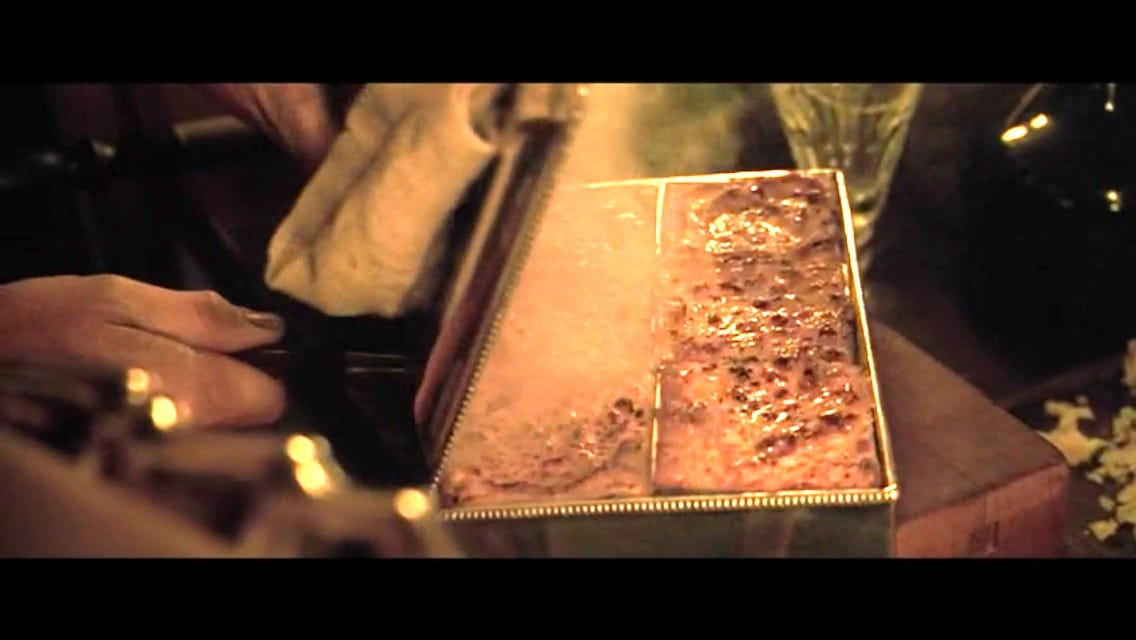
Killick’s only other culinary accomplishment is the toasted cheese from which this Substack takes its name, but he doesn’t become associated with the dish until Desolation Island:
‘When am I to be given my supper?’ asked Stephen. ‘You invited me to partake of toasted cheese, in luxury. I find no luxury, but a shambles: I find no toasted cheese, but a host groping for jocosity about what is in fact a grave and painful disease. Yet stay, I think I do perceive the smell of cheese above the powder-reek and the stench of that vile dark-lantern. Killick, belay there; are you now about the cheese?’
In my recent rereading of Post Captain, I was fascinated to see the Killick we know slowly emerge from the shell of the older model over the course of that very long novel. In the early chapters, Killick continues to play the role of dutiful servant, who addresses his master with disarming, even nauseating, politeness. It’s not until deep in Chapter 3 that we first hear our man speaking in his own voice. Notably, it is in defense of his captain, and risks incurring the wrath of Stephen, caught in the act of self-medicating:
‘I am not strongly tempted to go to Mapes; I am not strongly tempted to drink up the laudanum whose drops I count so superstitiously each night. Four hundred drops at present, my bottled tranquillity. Yet I do so. Killick,’ he said, with the veiled dangerous look of a man interrupted at secret work, ‘what have you to say to me? You are confused, disturbed in your mind. You have been drinking.’
Killick stepped closer, and leaning on Stephen’s chair he whispered. ‘There’s some ugly articles below, sir, asking for the Captain. A blackbeetle in a scrub wig and a couple of milling coves, prize-fighters. Awkward buggers in little round hats, and I see one of ’em shove a staff under his coat. Bums. Sheriff’s officers.’
Stephen nodded. ‘I will deal with them in the kitchen. No, the breakfast-room: it looks on to the lawn. Pack the Captain’s sea-chest and my small valise. Give me those letters of his. Put the mule to the little cart and drive to the end of Foxdene lane with our dunnage.’
Killick again proves his worth in Chapter 8, when he joins Jack aboard his temporary command HMS Lively and saves the barky from disgrace with a hamper of food from Mapes and game from Admiral Haddock. Granted, there has been a certain amount of breakage—”I have just these few bottles left,” Jack tells Canning during their dinner party, “happily my steward does not care for burgundy”—but this is a price Jack seems willing to play for Killick’s fundamental, unshakeable loyalty.
It is a loyalty that gets extended to Stephen as well, as Jack recounts in one of his letters to Sophie in The Fortune of War:
You would laugh to see Killick looking after Stephen, as he has been doing ever since Stephen’s servant – a half-wit – went away in the boats. Stephen is very unwilling to be looked after, but Killick has taken it into his head that it is his duty, and sews on buttons, washes and darns his two and a half shirts, irons his neckcloth, brushes his only decent coat, and makes him shave at least once a week by steady nagging in that grating voice of his, in spite of any amount of abuse – it is like an old angular mother-hen with a fractious chick.
Here again that feminizing language. In the (mostly) all-male world of the Royal Navy, men must take on the nurturing roles traditionally accorded to women. In Post Captain, the Williams family is amazed at the cleanliness of the all-male household of Melbury Lodge, though the decorating style is a bit “rigid,” all right angles like aboard ship. Jack, like the common sailors (but not, interestingly, like most of his fellow officers, who have not had his experience of having been turned before the mast), is skilled with needle and thread, making use of his hussif more than once to sew on a button for Stephen or darn his coat. There are other forms of nurturing in the books: Stephen, of course, nurtures his patients, though his bedside manner can be a little uneven (“How is your penis?”), while Jack takes seriously his responsibility for educating his midshipmen both in navigation and deportment. But Killick’s entire role, as steward, is to nurture and care for his captain, providing for Jack’s bodily needs so that Jack can concentrate on doing what he does best. Much of the comedy of their byplay comes in the contrast between Jack’s traditionally masculine battle-readiness and Killick’s appalled concern for the consequences to Jack’s clothes:
Jack had known Killick ever since his first command, and as he had risen in rank so Killick’s sullen independence had increased; he was angrier than usual now because Jack had wrecked his number three uniform and lost one of his gloves: ‘Coat torn in five places – cutlass slash in the forearm which how can I ever darn that? Bullet ’ole all singed, never get the powder-marks out. Breeches all a-hoo, and all this nasty blood everywhere, like you’d been a-wallowing in a lay-stall, sir. What Miss would say, I don’t know, sir. God strike me blind. Epaulette ’acked, fair ’acked to pieces. (Jesus, what a life.)’ (HMS Surprise)
Is this not an instance of Hegel’s famous lord-bondsman or master-slave dialectic (though “master and man” makes more sense in this context)? In Hegel’s parable, the master seems to have all the power, while the man must labor on his master’s behalf. But things are not so simple: the master not only depends upon his man for the necessities of life; he depends upon the recognition of his man to maintain his identity as master. Hegel calls the struggle between these two figures the “death struggle”: “In this struggle the lord emerges as lord because he does not fear death since he does not see his identity dependent on life, while the bondsman out of this fear consents to servitude. This experience of fear on the part of the bondsman is crucial, however, in a later moment of the dialectic, where it becomes the prerequisite experience for the bondsman's further development.” Killick, as man, must reckon with the consequences (“all this nasty blood”) of his master Jack’s fearless courtship of death in battle. He never challenges Jack directly, but his grumbling permits him to release some of the negativity of his position. Immediately preceding the passage above, Jack reflects: “Killick was a cross-grained bastard, who supposed that if he sprinkled his discourse with a good many sirs, the words in between did not signify: but still he had procured this coffee, these eggs, this butter, this soft tack, on shore and had put them on the table the morning after a hot engagement.” It is Killick’s job to work with nature and shape its products for his master; as Hegel’s dialectic proceeds, the man eventually recognizes his own creativity and is no longer alienated from his labor. Meanwhile, the master becomes wholly dependent upon his man until he is, for all intents and purposes, his servant’s slave.

Something too much of this. Killick is not an emissary of the proletariat; in accordance with the small-c conservative politics of the series, he remains loyal to Jack through thick and thin: through mutinies, maroonings, shipwrecks, and even Jack’s complete inability to pay him, Killick remains at his captain’s side. When Jack is suffering, Killick is almost tender; when Jack is riding high, as captain or commodore, Killick’s insufferable bray can be heard from stem to stern. Perhaps he lacks the imagination (Hegel’s creativity) to disidentify himself with Jack; nothing makes Killick happier than staying up all night polishing the silver he doesn’t own, or fighting with the hereditary butler over the privilege of bringing his master the post when in residence at Woolcombe. This doesn’t mean that he doesn’t achieve, at times, a certain motherly authority over his charges: “such was Killick’s total conviction, his moral superiority, that the one waited for his longed-for coffee without complaint and the other not only washed obediently but would have shown both hands, front and back, if required” (The Yellow Admiral).
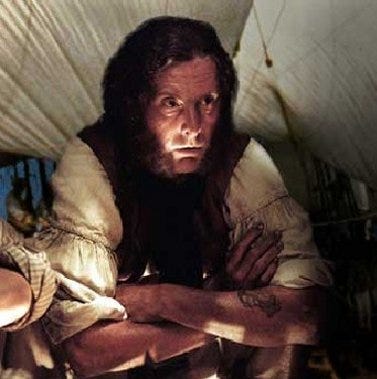
The finer things elude Killick: he never gets over his habit of serving a formal dinner by jerking his thumb or chin while remarking “Wittles is up"; he has nothing but contempt for Jack and Stephen’s musical tastes: “There they are, at it again. Squeak, squeak; boom, boom. And when they do start a-playing, it’s no better. You can’t tell t’other from one. Never nothing a man could sing to, even as drunk as Davy’s sow” (The Nutmeg of Consolation). His morality, too is crude; he is forever listening at doors, in a kind of parody of Stephen’s intelligence work, and his sexual morality is also questionable, as seen in this episode in Desolation Island in which—shades of Hardy’s The Mayor of Casterbridge—Killick buys himself a wife, though naturally not without Jack’s approval:
‘Well, Killick,’ he said, when the pair stood before him, his steward an ugly slab-sided middle-aged man rendered more awkward than usual by his present bashfulness, the young woman a snapping black-eyed piece, a perfect sailor’s delight. ‘Well, Killick, I trust you are not rushing into matrimony without due consideration? Matrimony is a very serious thing.’
‘Oh no, sir. I considered of it: I considered of it, why, the best part of twenty minutes. There was three to choose on, and this here –’ looking fondly at his purchase – ‘was the pick of the bunch.’
‘But, Killick, now I come to think of it, you had a wife in Mahon. She washed my shirts. You must not commit bigamy you know: it is against the law. You certainly had a wife in Mahon.’
‘Which I had two, your honour, t’other in Wapping Dock; but they was more in the roving, uncertificated line, if you follow me, sir, not bought legal, the halter put into my hand.’
‘Well,’ said Jack, ‘so I suppose you want to add her to the establishment. You will have to go in front of the parson first, however: cut along to the Rectory.’
Aside from the comedy, this episode strikes me as a bit of reassurance as to Killick’s heterosexuality, the specter of which recurs throughout the novels in sometimes complicated ways. When all’s said and done, I think O’Brian was basically a liberal on the subject, and he treats his homosexual characters with compassion, even as he occasionally strays into stereotype. Mrs. Williams, of course, wonders whether the strange rumors she’s heard about sailors could be true: “Was it not very odd that he should live with Dr Maturin?” (Post Captain). Nothing distresses Jack more than the prospect of having to try or hang a shipmate for “article thirty-nine” (actually twenty-nine): “If any person in the fleet shall commit the unnatural and detestable sin of buggery and sodomy with man or beast, he shall be punished with death by the sentence of a court martial.” Occasional discussions of homosexuality between Jack and Stephen are met with comic obtuseness:
‘Jack,’ he said, as they walked along the rim of the crater to a point where they could hail the ship, ‘did you reflect upon Ganymede at all?’
‘Yes,’ said Jack. ‘I was up with him all last night, and should be this night were it not for the Sultan’s visit tomorrow. Such an endearing little pale golden body as he peeps out – he is easily my favourite. But I shall still have him almost all night, once the Sultan is done with.’
‘Shall you, though?’ said Stephen, looking at his friend’s pleased, well-fed face, rather more florid than usual from the Sultan’s wine; and after a pause, ‘Brother, can we be talking of the same thing?’ (The Thirteen-Gun Salute)
It is sexual desire of any sort—homo or hetero—that troubles the wooden world over which Jack presides; what Stephen calls Jack’s “largely theoretical” misogyny really boils down to his fear of the damage unchecked sexual desire and jealousy do to the efficiency of the man-of-war as fighting machine. Killick, in spite of his multiple marriages, remains a reassuringly asexual creature (the “snapping black-eyed piece” turns out to be a con artist who leaves Killick for her original husband after stripping him bare). The real meaning of preserved in “Preserved Killick” is, after all, “preserved from sin.” We might say he refuses carnal knowledge to the same degree he refuses the final stage in Hegel’s dialectic, which would liberate him from the spell of servitude, breaking the canon’s utopian spell. For the canon can only be utopian insofar as the reader identifies with Jack and Stephen as officers, who may sympathize with the lower deck but always regard it as fundamentally other.
In H.M.S. Surprise the hapless (and rather effeminate) envoy Stanhope relates to the men he sails with on the following basis: “Once he had established that Jack and Hervey were connected with families he knew, he treated them as human beings; all the others as dogs – but as good, quite intelligent dogs in a dog-loving community.” Does Jack—does the reader—really treat Killick so very differently than Stanhope does? I am reminded of Alexander Pope’s famous epigram, supposedly engraved upon the collar of a dog belonging to the Prince of Wales:
I am his Highness’ dog at Kew;
Pray tell me, sir, whose dog are you?
Every hierarchy—and the Royal Navy is nothing if not hierarchical—needs a bottom as well as a top, and while Killick enjoys a higher status than your ordinary seaman, he is certainly near the bottom of the Surprise’s org chart. He is as loyal as a dog, and as gruff, far from perfectly housetrained and wary of change—the embodiment of the oft-repeated saw, “it was what they were used to.” His cross-grained temperament also serves as a kind of check on Jack’s delusions of grandeur, a little like the servant whose job it supposedly was to remind Marcus Aurelius that he would someday die. Stephen often muses how it is that Jack is not frozen or destroyed as a human being by the godlike authority he wields; the crooked timber of Killick’s humanity provides a partial answer.

I have long contemplated an essay on the canon on the Surprise, et al, as a kind of floating coffeehouse—the intellectual and social nerve-center of 18th century London, but mobile. I shall get to it one of these days.
I'm obsessed with the first two words of your subtitle.
Wonderful! I smiled through the whole reading.